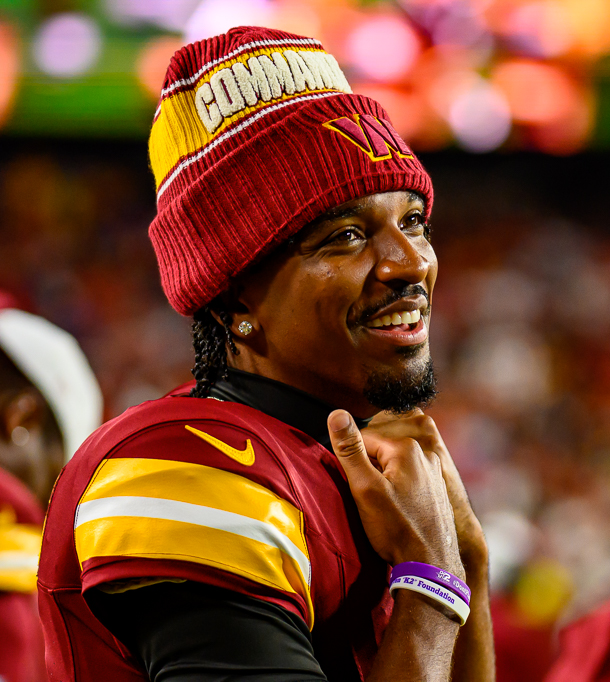
Grab your abacus, calibrate your expected points added (EPA) models, and dim the lights, because we have witnessed an offensive masterclass. On Monday Night Football, rookie quarterback Jayden Daniels walked into Paycor Stadium and systematically dismantled the Cincinnati Bengals defense like a senior developer rewriting spaghetti code. Washington walked away with a stunning road victory that not only blew the NFC East race wide open, but also plunged the Queen City into pure existential dread.
The Math Behind the Mayhem
Lou Anarumo is widely considered one of the NFL's premier defensive chess players, but against Kliff Kingsbury's spread concepts, the Bengals defensive coordinator looked like someone trying to play Blitz chess with boxing gloves on. Daniels was remarkably poised against Cincinnati's split-safety shells. Rather than panicking when Cincinnati disguised coverage pre-snap, Daniels processed leverage at an elite processing speed. When the pocket collapsed, his scrambles were not chaotic prayers; they were hyper-efficient gains aimed directly at the soft underbelly of Cincinnati's perimeter pursuit.
The Bengals defense looked completely pedestrian, failing to force a single punt the entire evening. While Cincinnati's offensive production was respectable on paper, their failure to convert in critical leveraged situations proved fatal. Much like the officiating gripes we saw when Jevon Holland slammed replay calls earlier this season, Bengals fans were quick to search for referee conspiracies regarding late-game clock management and uncalled alignment penalties. But let us be mathematically honest: blaming an uncalled illegal formation when your defense surrendered an EPA/play worse than a prevent unit in garbage time is classic statistical denial.
🐦 @FilmRoomNerd: "Jayden Daniels completion percentage over expectation (CPOE) tonight should be classified as a cyber weapon. Cincinnati's secondary was playing zone coverage in different zip codes."
💬 u/BunglesNoMore: "I don't want to hear about the referee clock runoff. We gave up points on literally every real possession. You cannot win games yielding a 100 percent success rate on third down."
Efficiency Comparison: Prime-Time Precision
| Metric | Jayden Daniels | Cincinnati Defense |
|---|---|---|
| Punts Forced | 0 | 0 (Inept) |
| Passer Rating | 141.7 | Opponent Allowed: Sky-High |
| High-Pressure Success Rate | 83.3% | 21.4% Win Rate |
| Red Zone Efficiency | 100% | Total System Crash |
The Hot Take Chamber
- Cincinnati's playoff margin is razor-thin: Starting in an 0-3 hole in the modern AFC means your margin for error drops to near zero. A wild-card berth now requires an unsustainable winning pace against top-tier schedule density.
- The Offensive Rookie of the Year race is essentially locked: If Daniels continues to generate explosive plays without turning the ball over, the betting markets will freeze before Thanksgiving.
- Washington's ceiling just shifted: This is no longer a rebuilding bridge season; Dan Quinn and Kingsbury have built an offense capable of dictating tempo against top AFC contenders.
Algorithm Forecast and Prop Sheet
Moving forward, regression will eventually rear its ugly head for Washington's historic offensive efficiency, but Daniels' dual-threat rushing floor provides a terrifying safety net for defensive coordinators. For upcoming Washington fixtures, hammer the over on team totals until oddsmakers adjust their baseline projections upward by at least four points. Meanwhile, on Cincinnati's side, place a speculative wager on defensive line snap counts being drastically overhauled before defensive coordinator Lou Anarumo loses his sanity completely.